

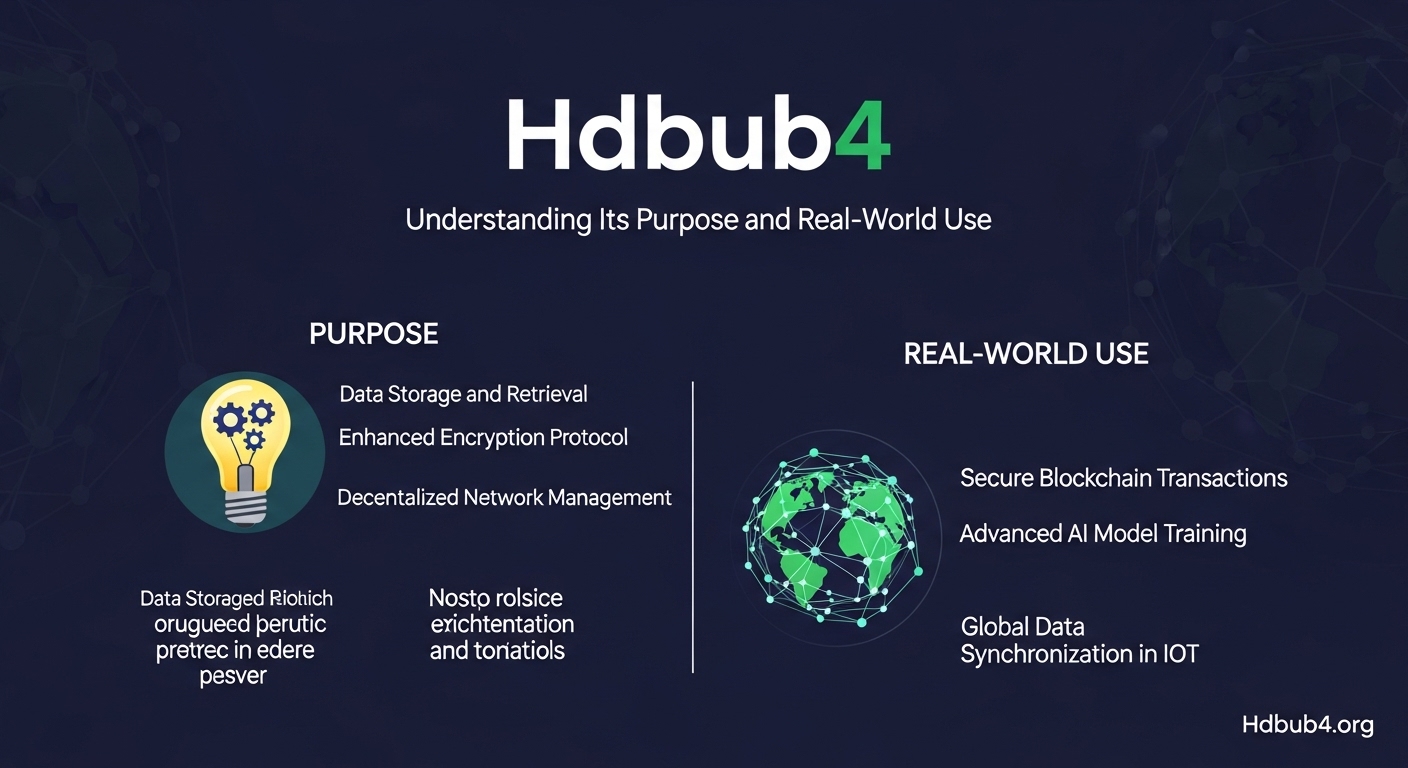
In today’s hyper-accelerated digital economy, most breakthroughs don’t arrive with fanfare. They slip quietly into workflows, reshape decision-making, and scale faster than their creators ever imagined. hdbub4 is one of those emerging frameworks subtle in name, but increasingly influential in how modern organizations structure data, automate intelligence, and build operational resilience. For startup founders, entrepreneurs, and tech professionals navigating growth amid uncertainty, understanding hdbub4 isn’t optional it’s strategic.
At its core, hdbub4 represents a new way of thinking about digital infrastructure. It blends adaptability, modular design, and data-first logic into a framework that aligns technology with real business behavior rather than abstract technical ideals. While still evolving, hdbub4 is already shaping how agile teams move from experimentation to execution without friction.
What hdbub4 Actually Means in a Business Context
Unlike traditional systems that prioritize rigid architecture, hdbub4 is built around flexibility. It’s not a single tool or platform, but a conceptual framework that emphasizes interoperability, lightweight automation, and decision-ready data. Businesses adopting hdbub4 focus less on overengineering and more on responsiveness how fast insights can travel from data to action.
In practice, hdbub4 encourages companies to rethink their digital stack as a living system. Instead of monolithic platforms that are expensive to change, teams design modular components that evolve alongside the business. This approach is especially attractive to startups and scale-ups that need speed without sacrificing long-term stability.
Why hdbub4 Is Gaining Traction Among Tech-Driven Companies
The growing interest in hdbub4 isn’t accidental. Founders and CTOs are facing a common set of challenges: fragmented data, bloated software stacks, and tools that don’t talk to each other. hdbub4 addresses these pain points by prioritizing clarity over complexity.
Rather than chasing the latest trend, organizations using hdbub4 focus on practical outcomes. They ask better questions: Does this system help us make faster decisions? Can it scale without doubling costs? Will it still work when our user base triples? The framework’s appeal lies in how naturally it aligns with those concerns.
hdbub4 and the Shift Toward Modular Digital Architecture
One of the defining characteristics of hdbub4 is its emphasis on modularity. Traditional enterprise systems often lock businesses into long-term commitments that are costly to modify. hdbub4 flips that model by encouraging interchangeable components that can be upgraded or replaced without disrupting the whole system.
This modular approach allows teams to experiment responsibly. New features can be tested in isolation, validated with real users, and either scaled or retired quickly. For startups operating under tight budgets, this reduces risk while accelerating innovation.
How hdbub4 Supports Data-Driven Decision Making
Data has never been more abundant—or more overwhelming. hdbub4 addresses this by emphasizing data usability, not just data collection. The framework promotes clean data flows, contextual analytics, and dashboards designed for decision-makers rather than data scientists alone.
When implemented effectively, hdbub4 shortens the distance between insight and execution. Leaders gain visibility into performance metrics that actually matter, while teams spend less time cleaning data and more time acting on it. This is particularly valuable in fast-moving markets where delays can erase competitive advantages overnight.
Comparing hdbub4 to Traditional Digital Frameworks
To better understand where hdbub4 fits, it helps to compare it with more conventional approaches:
| Aspect | Traditional Frameworks | hdbub4 Approach |
|---|---|---|
| Architecture | Rigid and centralized | Modular and adaptive |
| Scalability | Costly and slow | Incremental and flexible |
| Data Flow | Siloed | Integrated and contextual |
| Decision Speed | Delayed by complexity | Optimized for action |
| Maintenance | High overhead | Lightweight and iterative |
This contrast explains why hdbub4 resonates with modern digital leaders. It doesn’t promise perfection—it promises progress without paralysis.
hdbub4 in Real-World Startup Scenarios
Consider a SaaS startup experiencing rapid customer growth. Traditional systems might require a full infrastructure overhaul to support new demand. With hdbub4 principles in place, the company can scale specific components such as analytics or customer onboarding without disrupting core operations.
In another scenario, an e-commerce brand experimenting with AI-driven recommendations can deploy and refine models within a modular hdbub4 framework. If a strategy fails, it’s isolated. If it succeeds, it integrates seamlessly. This balance of experimentation and stability is what makes hdbub4 so compelling.
The Role of hdbub4 in Long-Term Business Resilience
Resilience isn’t just about surviving disruption it’s about adapting faster than competitors. hdbub4 supports resilience by reducing dependency on any single tool or vendor. When market conditions shift, businesses can pivot their systems without starting from scratch.
This adaptability also extends to talent. Developers and engineers prefer working in environments where systems make sense and evolve logically. hdbub4’s clarity makes onboarding easier and reduces technical debt, which quietly erodes productivity in many organizations.
Challenges and Misconceptions Around hdbub4
Despite its advantages, hdbub4 isn’t a magic solution. One common misconception is that it eliminates the need for strategy. In reality, it demands better strategy, not less. Without clear goals, modular systems can become fragmented.
Another challenge lies in mindset. Organizations accustomed to rigid hierarchies may struggle with the flexibility hdbub4 requires. Successful adoption depends as much on cultural alignment as technical execution. Leaders must be willing to empower teams and trust iterative improvement.
How to Know If hdbub4 Is Right for Your Organization
hdbub4 is best suited for businesses that value speed, learning, and adaptability. If your organization operates in a stable environment with minimal change, traditional systems may suffice. But if you’re navigating growth, uncertainty, or innovation, hdbub4 offers a framework that grows with you.
The key is intentional adoption. Rather than rebuilding everything at once, companies often start by applying hdbub4 principles to a single workflow. Over time, those principles spread organically as teams see tangible results.
The Future Outlook of hdbub4
As digital ecosystems become more interconnected, frameworks like hdbub4 are likely to gain momentum. The future favors systems that can evolve without constant reinvention. hdbub4’s emphasis on modularity, data clarity, and real-world usability positions it well for that future.
For tech professionals and founders alike, understanding hdbub4 isn’t about chasing a buzzword. It’s about recognizing a shift in how successful organizations think about technology—as a flexible partner, not a rigid constraint.
Conclusion: Why hdbub4 Matters More Than It Sounds
hdbub4 may not dominate headlines, but its influence is quietly spreading across modern digital teams. By prioritizing adaptability, clarity, and decision-ready data, it offers a practical path forward for businesses that refuse to be slowed down by their own systems.
For startups and enterprises alike, the value of hdbub4 lies in its realism. It acknowledges that change is constant and builds systems that embrace it rather than resist it. In a world where agility often determines survival, that mindset can make all the difference.